Information Collection Discontinuation and Revision
The Paperwork Reduction Act (PRA) aims to minimize the public paperwork burden while maximizing the utility of federal data. Under this framework, the Office of Information and Regulatory Affairs (OIRA) within the Office of Management and Budget (OMB) review and approve information collection requests (ICR) that agencies use to generate data from individuals and organizations. Under the PRA, agencies must notify the public of their intent to collect new data or modify an existing collection obtain OIRA approval and an OMB Control Number for new collections. The OMB Control Number is valid for a maximum of three years. While public notice and approval from OIRA is required for nearly all (non-exempt) ICRs by a federal, discontinuation of a collection - and thus the stream of data it generates - may follow a different path depending on the nature of the ICR. Discontinuation represents a real, albeit mundane, administrative risk to the integrity of federal data.
Discontinuation
Agencies typically discontinue collections through one of three mechanisms. The most formal discontinuation mechanism involves ICRs associated with a specific federal regulation. Because these collections are mandated by the Code of Federal Regulations (CFR), agencies cannot unilaterally stop collecting the data. Under 5 CFR Part 1320, they must seek explicit OMB permission to discontinue the ICR and publish a notice in the Federal Register. This process is usually accompanied by a proposed rulemaking to formally remove the requirement, providing high public visibility and an opportunity for stakeholders to comment on the loss of data.
For ICRs not tied to a regulation, the discontinuation process requires fewer steps. An agency can formally discontinue the collection at its own prerogative. If leadership decides the data is no longer relevant to their mission, they can officially close out the ICR. In these instances, the agency posts a notice of discontinuation on the OMB tracking portal, reginfo.gov. This creates an official administrative record but lacks the broader public notification and formal comment period of a Federal Register notice.
A third mechanism is passive expiration. Because every OMB Control Number has a maximum lifespan of three years, an agency can terminate a collection simply by allowing the approval to expire. This can happen due to the natural end of a temporary survey, reduced administrative capacity, or shifting agency priorities. Consequently, the data collection ends quietly without any formal public notification.
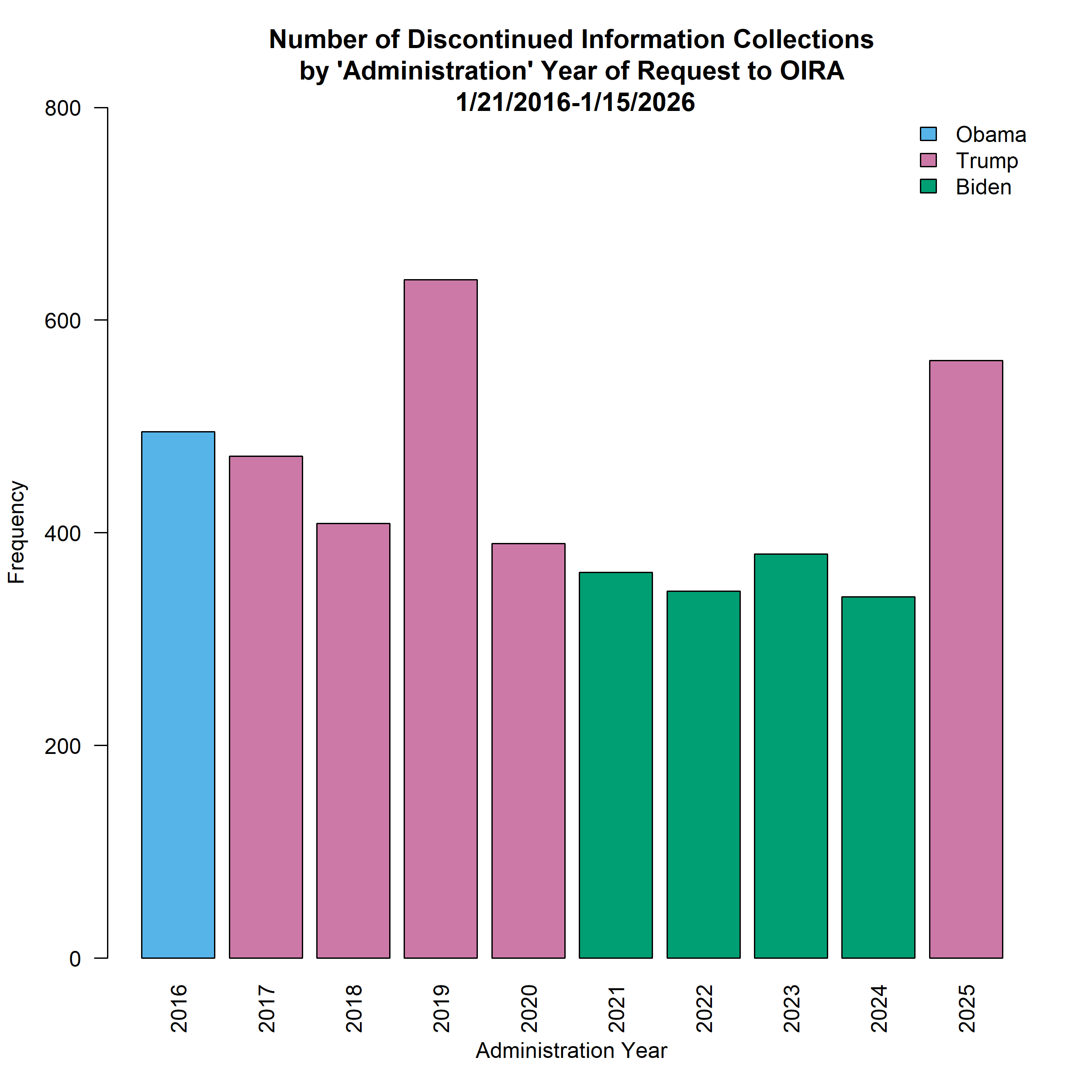 Figure: The pra-icr-tools package was used to extract data from OIRA’s ICR search tool on all discontinued information collections between 01/21/2016 and 1/20/2026 in ten annual steps. The annual steps were mapped to Administration Years such that they initiate on the 21st of January and conclude on the 20th of January in the subsequent year. This ensures that discontinuation actions were requested by federal agencies correcting for Presidential inaugurations. The Date Type field was set to discontinued for each of the ten steps.
As Gretchen Gehrke points out in a 2026 editorial for The Hill (Gehrke, 2026), discontinuation represents one of the most commonly used tools by the Trump Administration in its efforts to reshape the federal data landscape. This is, in part, due to the connection between ICRs and deregulatory actions taken by agencies in fulfillment of both the 2-for-1 and 10-for-1 deregulation executive orders in the first and second Trump Administrations. Rescinding regulations reduces the number of information collections conducted by federal agencies. Data on information collection discontinuations is available through OIRA’s reginfo.gov website. Between January 21st, 2025 and January 20th, 2026 this Administration had discontinued at least 562 information collections which is 65% more than the Biden Administration had discontinued in the same interval the year prior. In broad comparison to the 1923 collections discontinued in five Democratic Administration years (Obama 2016, Biden 2021-2024), the Trump Administration has discontinued nearly 2471, or about 30% more.
Revision
Of course, information collection discontinuation results in the complete loss of future data collections. However, the PRA process is also regularly used to modified continuing collections as well, especially by removing or changing survey items. In the last year alone, Executive Order 14168 (EO 14168) required agencies to make significant changes to information collections to gender identify resulting in changes to at least 360 individual surveys (Bouton & Redfield, 2026; Klein & Medina, 2026). As discussed in the chapter reviewing data integrity issues at the US Department of Veteran’s Affairs many of these changes involved response-option and variable name revisions and were sanctioned by OIRA despite the office’s historical resistance to dramatic changes to survey collections (Office of Management and Budget, 2025). Such hasty, unscientific, collection revision should be considered an additional risk to data integrity.
While there are limited avenues for public comment to voice concerns over data discontinuation (or, relatedly, passive expiration of the OMB Control Number that authorizes a collection to continue), there are often ample opportunities for such comment during revision collection process. In response to the quiet disappearance of data and the opaque nature of government tracking systems like reginfo.gov and the Federal Register, independent monitoring by dataindex.us emerged to increase transparency and advocate for public input through the notice and comment process during information collection request revisions. The dataindex.us platform actively tracks ICRs and aggregates proposed changes to federal surveys and forms to help data users stay informed. By simplifying the complex information published by OIRA, the site makes otherwise invisible administrative shifts visible to policymakers, journalists, and researchers. Crucially, dataindex.us plays a vital role in amplifying the use of public comment by highlighting specific opportunities for stakeholders to weigh in on data collections, organizing these opportunities. Through weekly newsletters, periodic blog posts, and detailed ICR tracking, the organization mobilizes the public to submit comments in an effort to support good governance and democratic principles in how the government collects data (Maury & Marcum, 2025). Of course, public comment is only effective when the opportunity exists - in the case of EO 14168, OIRA circumvented the notice and comment process by authorizing agencies to invoke “non-substantative” changes justifications which do not require the full PRA review process.
Conclusion
In general, agencies are not allowed to delete datasets generated through an information collection that has been discontinued or revised. Discontinuation ceases collection only and does not de-obligate federal agencies (or OIRA) from following law and policies on data retention, protection, and sharing: agencies are still obligated to assess the data assets produced by those collections, inventory them in their comprehensive data inventories, make those datasets meeting certain requirements publicly accessible, and follow the Federal Records Act disposition processes. While public notice and comment is typically available for requests for revision to continuing collections subject to the PRA, the same transparency is only partly available for discontinuations. For all datasets that rise to the level of being “significant information”, however, agencies are suppose to follow the guidance in OMB Circular A-130 when making changes to collections resulting in high-value data assets (even if they are not subject to the PRA). This circular governs federal information management and requires agencies to provide “adequate public notice” before substantially modifying or terminating “significant information products” (Office of Management and Budget, 2016). The policy is designed to ensure stakeholders, including other federal agencies, who rely on the data are informed and can provide input prior to its removal. When agencies let the OMB control numbers for these significant products expire passively or discontinue them on reginfo.gov without broad announcements, they bypass the transparency safeguards outlined in Circular A-130. As a result, valuable government data collections can disappear quietly, directly undermining the continuity and integrity of the federal data ecosystem.
References
- Bouton, L. J. A., & Redfield, E. (2026). Removal of Sexual Orientation and Gender Identity from Federal Data Collections: January 2025 to January 2026. Williams Institute. https://williamsinstitute.law.ucla.edu/publications/sogi-data-collection-removal/
- Gehrke, G. (2026). The Trump administration is disappearing climate change data. The Hill. https://thehill.com/opinion/energy-environment/5756951-federal-data-threatened-trump-era/
- Klein, M., & Medina, C. (2026). One Year In: The Cost of Rolling Back Federal LGBTQ Data. America’s Data Index. https://dataindex.us/newsletter/article/f69108a5-7346-4257-9fbc-e2ef784bd96b
- Maury, M., & Marcum, C. (2025). How You Can (and should) Shape Federal Data Collections. America’s Data Index. https://dataindex.us/newsletter/article/6cfecae3-3c89-487e-b8f7-cfcd85ded6c7
- Office of Management and Budget. (2025). Guidance on Implementing Section 3(e) of Executive Order 14168 in Accordance with the Paperwork Reduction Act and the Privacy Act. Office of Information and Regulatory Affairs.
- Office of Management and Budget. (2016). Circular No. A-130: Managing Information as a Strategic Resource. Executive Office of the President. https://www.whitehouse.gov/wp-content/uploads/legacy_drupal_files/omb/circulars/A130/a130revised.pdf