Resourcing and Staffing
Actions taken by the Administration to reduce the size of the federal workforce and restructure data-generating programs in 2025 posed some of the most significant risks to the integrity of federal data in 2025. These reductions, initiated through hiring freezes, deferred retirement and other separation incentives, budget cuts, and program restructuring, led to a substantial loss of institutional capacity to sustain prior levels of data collection, curation, and dissemination. In the federal data ecosystem, resourcing and staffing risks were significant both inside and outside of the federal statistical system (Bowen et al., 2025; Gehrke, 2026; Smith, 2026). This chapter provides a broad overview of both theoretical and realized risks to federal data from administrative changes to staffing and program support. More comprehensive reporting is available in the references.
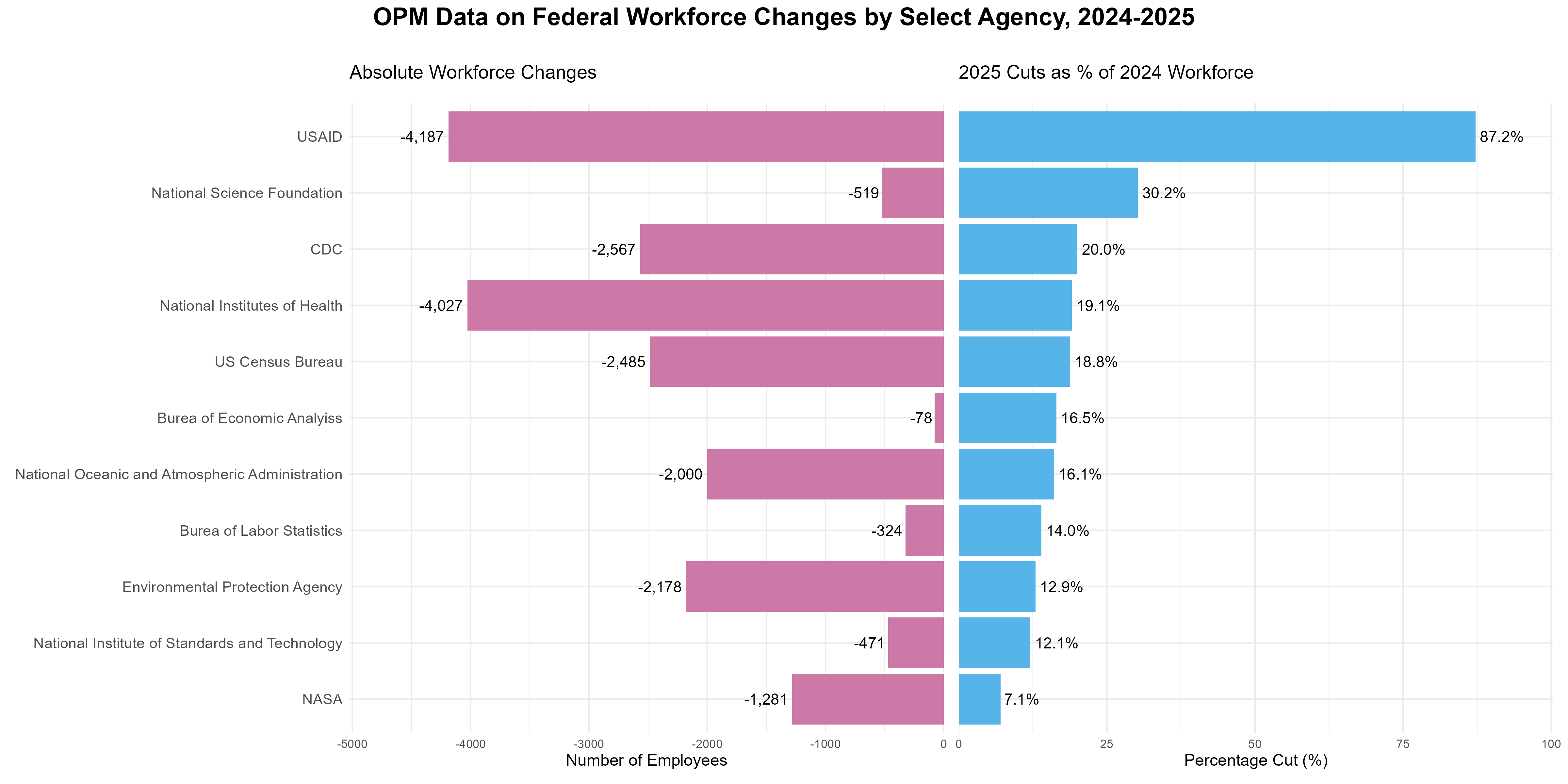 Figure: Data from the OPM EHRI 12/31/2025 release was used to illustrate workforce changes in select federal agencies between 12/31/2024 and 12/31/2025. Agencies were selected for their role in generating a significant volume of open government data. Both the absolute change in the number of agency employees and the turnover as a percent of the 2024 workforce size are represented in the graph. The data differ slightly from that reported by the American Statistical Association (ASA) in the Nation’s Data At Risk because these figures represent adjustments made by OPM since the ASA report was published.
Impact on the Federal Statistical System
In 2025, the federal statistical system experienced widespread workforce contractions and resourcing constraints, a pattern of under-resourcing that has plagued the system for years (Auerbach et al., 2024). The American Statistical Association (ASA) reported that all 13 principal statistical agencies lost staff during this period and data-generating programs were cut as well (Bowen et al., 2025). Most statistical agencies lost between 20 percent and 30 percent of their professional staff. Statistical products were discontinued or removed from public access because data collection pipelines ended when contracts were cut, funding lapsed, or technical staff were unavailable to process the data (Heckman, 2025). For example, the Energy Information Administration, the Department of Energy’s statistical agency, lost approximately 40% of its staff—over 100 out of approximately 350 employees. As a result, the EIA canceled the publication of its International Energy Outlook for 2025, a 70-page statistical report detailing global trends, specifically citing the “loss of key resources” and staff (Dayak & Kramer, 2026; Elkind, 2025). The disruption at EIA led agency leadership to request “all hands-on-deck” to preserve institutional knowledge for future capacity before the mass departure (LaRose, 2025).
Perhaps hardest hit of all federal statistical agencies, The Bureau of Labor Statistics (BLS) faced compounding pressures from political turmoil, staff reductions, budget cuts, and pressures to modernize in the context of long declining survey response rates (Auerbach et al., 2024). A 43-day government shutdown in late 2025 prevented the execution of employment and inflation surveys for the first time in nearly 80 years (missing reference). This historic shutdown produced an irrecoverable gap in the modern unemployment rate series dating back to 1948 and halted the publication of the Consumer Price Index (CPI) in its modern form. The BLS also experienced severe headcount declines. By the time Commissioner Erika McEntarfer was fired by President Trump on August 1, 2025, BLS had lost up to 22 percent of its staff and left numerous leadership roles unfilled (American Statistical Association, 2025); though, some positions have apparently since been restaffed according to updated OPM data. The agency also suspended CPI data collection entirely in Lincoln, Nebraska; Provo, Utah; and Buffalo, New York. It reduced the sample size in 72 other areas by 15 percent (U.S. Bureau of Labor Statistics, 2025). Furthermore, the BLS discontinued the calculation and publication of approximately 350 specific Producer Price Index (PPI) series (U.S. Bureau of Labor Statistics, 2025).
Effect on Confidential Statistical Data
While public attention heavily focused on the impact these disruptions had on open government data, a quieter and equally damaging disruption occurred within the secure data ecosystem. Federal statistical agencies house repositories of confidential statistical data (such as individual tax records, health behavior data, business establishment data, and student records) that cannot be published openly due to statistical confidentiality laws (Levenstein & Kubale, 2025). Confidential statistical data are protected by the Confidential Information Protection and Statistical Efficiency Act of 2018 (CIPSEA), which makes it a class-E felony for unlawful disclosure of data collected under a pledge of confidentiality. Those protections, however, are not automatic. They require oversight and implementation by highly skilled staff at the statistical agencies. When the staff who run those processes are lost - or the programs supporting those staff are defunded - it is increasingly likely that agencies will both limit release of open government data and limit access to confidential statistical data products. Neither outcome is desirable for a public statistical system that depends on both trust in confidentiality and public usability.
In another extreme example from the federal statistical system, The National Center for Education Statistics (NCES) staff was reduced to approximately three employees (Bowen et al., 2025) in 2025. This reduction severely limited the agency’s ability to manage complex datasets, notably the Integrated Postsecondary Education Data System (IPEDS) and the National Assessment of Educational Progress (NAEP). Under-staffing was so bad at NCES, that the Office of Management and Budget (OMB) required the agency to remove CIPSEA protections from the NAEP as the agency could not meet its obligations under the law to protect those data (U.S. Department of Education, 2025), resulting in considerable push-back from stakeholders.
Usually, researchers and other data users gain access to confidential statistical data through secure enclaves by submitting project proposals that are rigorously reviewed by federal staff. The Federal Statistical Research Data Center (FSRDC) program serves as the primary secure environment for accessing restricted federal data requested though the Standard Application Process (SAP). Under the Foundations for Evidence-Based Policy Making Act of 2019 (Evidence Act). federal statistical agencies are charged with simultaneously protecting confidentiality while simultaneously increasing public access to statistical data. The FSRDC and SAP programs work hand-in-hand to accomplish that dual charge. However, the administrative disruptions to statistical agencies described here significantly jeopardized the integrity of this system.
For example, NCES has been unable to process access requests to their confidential statistical data since at least May of 2025. Even before the full impact of the agency’s upset would be fully appreciated, the Bureau of Labor Statistics (BLS) abruptly stopped participating in the FSRDC program very early in 2025. This decision immediately cut off academic and institutional researchers from analyzing restricted establishment and labor microdata necessary for complex economic modeling.
Consequently, agencies stopped reviewing new data access requests through the SAP and paused disclosure review of existing projects ongoing in the FSRDC program had to be halted as agency staff were not available to provide disclosure review of manuscripts and aggregated data extracts intended for publication. The paralysis of the confidential statistical data ecosystem was formalized through notices posted to the SAP portal, the centralized federal system for requesting access to confidential data. The SAP portal and program staff (housed at the National Center for Science and Engineering Statistics (NCSES) at the National Science Foundation) explicitly notified researchers of massive programmatic shutdowns throughout 2025 per OMB guidance. As of the publication of this report, the portal still indicated the following notices:
“Note: the Internal Revenue Service Statistics of Income did not have a 2025 Joint Statistical Research Program application window and is not accepting new proposals, with a re-evaluation of the program’s status to occur at a date to be determined. This action does not impact requests to access commingled Federal Tax Information through the Federal Statistical Research Data Centers.”
“Note: the National Center for Education Statistics is not accepting new proposals or reviewing proposals.”
“Note: the SAMHSA Center for Behavioral Health Statistics and Quality is accepting applications for the National Survey on Drug Use and Health.”
Administrative disruptions to restricted data assets outside of the federal statistical system were also prevalent in 2025 and continue into 2026. The CDC’s popular Pregnancy Risk Assessment Monitoring System (PRAMS), for example, was widely reported to be at risk of discontinuation (Hamad et al., 2026). While the CDC PRAMS website providing access to reports using its data was restored as a result of a lawsuit (Alder, 2025), review of data access requests is still on pause as indicated by this disclosure on its website:
“PRAMS ARF data requests are not currently being processed. Researchers wanting to analyze data can contact each site separately to request access to their data. Please email the point of contact or visit the website for each of these sites for more information. (Participating PRAMS Sites)”
Impact on Other Agencies
A similar pattern of staffing and resourcing disruption to federal data also appeared outside the federal statistical system in 2025. Program disruptions across US federal agencies through separations, contract cancellations, and other administrative hazards have been widely reported elsewhere. However, it’s useful to examine an illustrative example that is representative of system-wide effects on federal data. What happened at the National Oceanic and Atmospheric Administration (NOAA), for example, provides one such exemplar.
Reuters reported that NOAA lost about 1,000 employees, or roughly 10 percent of its workforce, in the early months of 2025 and that at least six National Weather Service offices had stopped routine twice-daily weather-balloon launches that feed weather models (Reuters, 2025). The total NOAA staff departures would rise to about 2,000 by the end of 2025, according to updated OPM data. Reuters also reported that the Administration’s FY 2026 budget proposal would eliminate NOAA’s Office of Oceanic and Atmospheric Research and proposed cutting funding for regional climate data, research labs, and cooperative institutes (Reuters, 2025).
Even though Congress has repudiated the Administration’s budget request in the final appropriations bills for most data-generating programs (Zimmermann, 2026), the loss of institutional capacity resulting from staff departures can have sustained effects on the integrity of federal data. For example, former U.S. Chief Data Scientist Denice Ross warned that the loss of staff and contractors at NOAA could lead to the physical decay of sensors that collect much of the climate data used in forecasting, such as the ground-based radar systems that protect rural areas from tornadoes, because there is no one left to fix the equipment if it malfunctions (Kim, 2025).
Conclusion
The drastic and widespread reductions in federal workforce and resourcing throughout 2025 fundamentally undermined the integrity of both open and confidential data in the US Federal government. By hollowing out subject matter experts and other critical staff across agencies the Administration reduced data integrity capacity in a systemic manner. Ultimately, this systemic disruption created lasting deficits in the nation’s ability to reliably collect, protect, and disseminate the vital data necessary for informed policymaking, economic forecasting, and scientific research. Noteably, the long-standing under-resourcing of the federal statistical system that existed before the current Administration came into power set the conditions for the losses experienced in 2025. A more resource-rich federal statistical system would have inherent resilience to budget cuts, staff reductions, and other capacity challenges that affect the ability of the agency to protect the integrity of the data assests they collect from, and disseminate to, the public.
References
- Alder, S. (2025). HHS Settlement Requires Restoration of 100+ Health Datasets and Tools. https://www.hipaajournal.com/hhs-settlement-lawsuit-restore-critical-health-information-federal-websites/
- Auerbach, J., Bowen, C. M. K., Citro, C., Pierson, S., Potok, N., & Seeskin, Z. (2024). The Nation’s Data at Risk: Meeting America’s Information Needs for the 21st Century. American Statistical Association. https://www.amstat.org/docs/default-source/amstat-documents/the-nation’s-data-at-risk—report.pdf
- Bowen, C. M. K., Citro, C., Crosby, M., Pierson, S., Potok, N., & Seeskin, Z. (2025). The Nation’s Data at Risk: 2025 Report. The American Statistical Association. https://www.amstat.org/policy-and-advocacy/the-nations-data-at-risk–2025-report
- Dayak, S., & Kramer, A. (2026). Federal Data Is Disappearing . NOTUS. https://www.notus.org/trump-white-house/federal-data-is-disappearing
- Elkind, P. (2025). The Latest Trump and DOGE Casualty: Energy Data. ProPublica. https://www.propublica.org/article/the-latest-trump-and-doge-casualty-energy-data
- Gehrke, G. (2026). The Trump administration is disappearing climate change data. The Hill. https://thehill.com/opinion/energy-environment/5756951-federal-data-threatened-trump-era/
- Hamad, R., Warren, M., Ross, D., Maury, M., & Jarosz, B. (2026). Rapid Response Data Briefing: Pregnancy Risk Assessment Monitoring System (PRAMS). Webinar hosted by dataindex.us, Association of Public Data Users, Population Reference Bureau, March of Dimes, and Population Association of America. https://dataindex.us/events/Rapid-Response-Data-Briefing-Pregnancy-Risk-Assessment-Monitoring-System-PRAMS
- Heckman, J. (2025). ’Bedrock’ federal data sets are disappearing, as statistical agencies face upheaval. Federal News Network. https://federalnewsnetwork.com/big-data/2025/12/bedrock-federal-data-sets-are-disappearing-as-statistical-agencies-face-upheaval
- Kim, A. (2025). Federal Data Are Disappearing. Washington Monthly. https://washingtonmonthly.com/2025/11/26/federal-data-are-disappearing/
- LaRose, A. (2025). Internal Memorandum [Email sent to all staff]. U.S. Energy Information Administration, Office of Energy Analysis. https://www.documentcloud.org/documents/25928821-larose-memo/
- Levenstein, M., & Kubale, J. (2025). Data that taxpayers have paid for and rely on is disappearing – here’s how it’s happening and what you can do about it. The Conversation. https://theconversation.com/data-that-taxpayers-have-paid-for-and-rely-on-is-disappearing-heres-how-its-happening-and-what-you-can-do-about-it-251787
- Smith, M. (2026). America’s Statistical System Is Breaking Down. Bloomberg. https://www.bloomberg.com/news/articles/2026-01-09/why-the-trump-administration-is-choosing-not-to-collect-some-us-data
- Zimmermann, A. (2026). FY 2026 R&D Appropriations: Final R&D Report. AAAS. https://www.aaas.org/sites/default/files/2026-02/Final%20Report%202026_0.pdf
- American Statistical Association. (2025). Bureau of Labor Statistics. https://www.amstat.org/docs/default-source/amstat-documents/the-nations-data-at-risk-2025/bureau-of-labor-statistics.pdf
- Reuters. (2025). NOAA "fully staffed" with forecasters, scientists, US commerce secretary says. https://www.reuters.com/world/us/noaa-fully-staffed-with-forecasters-scientists-us-commerce-secretary-says-2025-06-04/
- Reuters. (2025). White House aims to eliminate NOAA climate research in budget plan. https://www.reuters.com/sustainability/climate-energy/white-house-proposes-eliminate-noaa-climate-research-budget-proposal-2025-04-11/
- U.S. Bureau of Labor Statistics. (2025). Notice of CPI collection reductions. https://www.bls.gov/cpi/notices/2025/collection-reduction.htm
- U.S. Bureau of Labor Statistics. (2025). BLS to Discontinue Selected PPIs. https://www.bls.gov/ppi/notices/2025/bls-to-discontinue-selected-ppis.htm
- U.S. Department of Education. (2025). Agency Information Collection Activities; Submission to the Office of Management and Budget for Review and Approval; Comment Request; National Assessment of Educational Progress (NAEP) 2026. In Federal Register. https://www.federalregister.gov/documents/2025/05/15/2025-08602/agency-information-collection-activities-submission-to-the-office-of-management-and-budget-for